Wireless Automatic Cut Off for N2 Cooling on an SMT Production Line
The N2 cooling zone on the SMT line at PT. Flextronics Technology Indonesia previously required long cable runs to connect the workpiece-detection sensor to the relay controlling the cooling supply. This project replaces that wiring with a Bluetooth-based Master–Slave system: a sensor unit detects the workpiece and wirelessly signals a relay unit to activate N2 cooling, keeping it on for as long as workpieces continue to pass, then automatically cutting it off 5 minutes after the sensor stops detecting a workpiece.
Project Overview
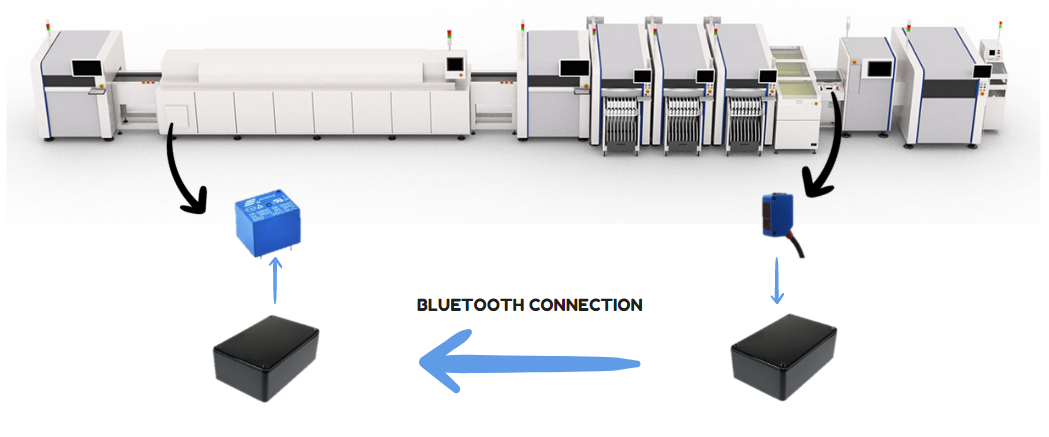
On the SMT (Surface Mount Technology) assembly line at PT. Flextronics Technology Indonesia, the N2 (nitrogen) cooling zone sits downstream of the reflow oven, positioned between several machine modules along the line. Controlling this cooling stage conventionally means running a hard-wired connection from the workpiece-detection point to the relay that switches the N2 supply — a cable path that has to cross multiple machine modules along the line.
This project replaces that hard-wired connection with a wireless Master–Slave system. A Master unit, fitted with a photoelectric sensor, detects each workpiece passing through the line and sends a signal over Bluetooth (HC-05) to a Slave unit positioned at the N2 relay point, up to 12 meters away. The Slave then activates the N2 cooling relay for as long as workpieces keep passing, and automatically switches it off 5 minutes after the sensor no longer detects a workpiece.
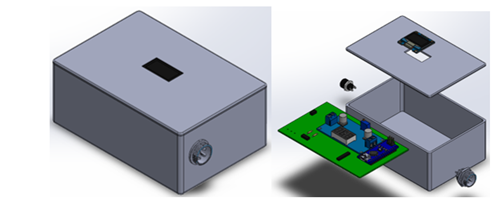
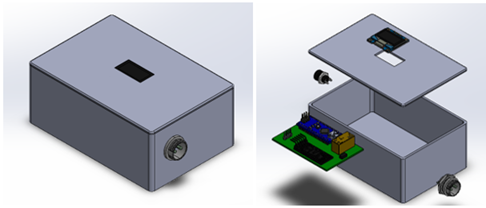
Each unit is built as a self-contained box with its own Arduino Nano, OLED status display, and Bluetooth module, so the sensor point and the relay point no longer need to be physically wired together across the machine line.
By eliminating long signal-cable routing across multiple SMT modules, the system reduces installation complexity, simplifies maintenance activities, and allows flexible deployment without modifying the existing production line infrastructure.
Problem Statement
- How can the N2 cooling relay be triggered from a workpiece-detection sensor located several meters away, without running a signal cable across the SMT machine line?
- How can the sensor unit reliably transmit detection signals and control timing functions over a wireless communication link?
Objectives
- Develop and implement a Bluetooth-based Master–Slave control system that automatically activates and deactivates N2 cooling according to workpiece detection events within an SMT production environment
System Architecture
The system pairs a Master unit that senses the workpiece with a Slave unit that switches the N2 cooling relay, linked over a Bluetooth HC-05 connection with a range of up to 12 meters — removing the need for a wired connection across the SMT line.
Line Survey & Concept
Studying the SMT line layout to map the distance and machine modules between the workpiece detection point and the N2 relay point.
Master & Slave Circuit Design
Designing the Master (sensor + Bluetooth) and Slave (relay + Bluetooth) circuits, including the PC817 optocoupler isolation between the 12V logic and 24V sensor supply on the Master unit.
Enclosure Design
Designing a CAD enclosure for the Master and Slave boxes to house the Arduino Nano, OLED display, and Bluetooth module for installation on the production floor.
Firmware & Wireless Testing
Programming the Master–Slave handshake logic on both Arduino Nano boards and validating the detection-to-cutoff sequence at production-floor distance.
Hardware Components
- Arduino Nano – Main controller (Master & Slave)
- Bluetooth Module HC-05 – Wireless Master–Slave communication
- Photoelectric Sensor – Workpiece detection
- Relay – N2 automatic cooling switching
- OLED Display – Visual status monitoring
Master Unit — Sensor Side
- Powered by 12V DC from the adapter, stepped up to 24V DC (XL6009) for the sensor supply
- An Optocoupler PC817 isolates the 24V sensor circuit from the 12V Arduino logic
- Consists of an Arduino Nano, BT HC-05, OLED display, and the photoelectric sensor input
Slave Unit — Relay Side
- Powered by 12V DC directly from the adapter
- Consists of an Arduino Nano, BT HC-05, OLED display, and the relay
- The relay's NC (Normally Closed) contact switches the N2 cooling supply
Implementation Results
The Master and Slave enclosures were designed and built to house each unit's electronics for installation on the production floor, and the complete system was validated end-to-end from workpiece detection to automatic N2 cut-off.
Enclosure Design
Each unit — Master and Slave — is housed in its own CAD-designed enclosure, sized to fit the Arduino Nano, OLED display, Bluetooth module, and power circuitry, with a dedicated DC jack port for power input, while keeping a compact footprint for installation in the limited space between machine modules along the SMT line.
Wireless Detection-to-Cutoff Sequence
Once the Master's photoelectric sensor detects a workpiece passing through, it sends an activation signal over Bluetooth to the Slave, which immediately closes the relay to switch on N2 cooling. The relay stays on for as long as workpieces continue to be detected, and only starts its 5 minutes off-delay once the sensor no longer detects a workpiece — removing the need for an operator or a wired signal path between the two points along the line.
| Parameter | Value |
|---|---|
| Wireless Link | Bluetooth HC-05, Master ↔ Slave |
| Max. Connectivity Range | 12 m |
| N2 Cooling Off-Delay | 5 minutes after last detection |
| Pairing | 1 Master : 1 Slave |
| Detection Trigger | Photoelectric sensor |
| Relay Response | Successful activation on each detection |
Communication & Functional Validation
The Bluetooth link between the Master and Slave units remained stable at the intended installation distance along the SMT line, up to 12 meters. Each workpiece detection event correctly triggered N2 cooling activation, and the relay reliably cut off 5 minutes after the sensor stopped detecting a workpiece, confirming that the wireless handoff between the sensor unit and the relay unit operates reliably without a hard-wired connection.
Engineering Outcomes
- Eliminated long-distance signal cable routing between the sensor location and the relay location
- Reduced installation complexity across multiple SMT machine modules
- Enabled flexible placement of the sensing and relay units without modifying existing line infrastructure
- Improved maintainability through a modular Master–Slave architecture
- DValidated reliable wireless triggering and automatic N2 cooling control over a 12-meter operating distance
Project Impact
The Wireless Automatic Cut Off for N2 system successfully replaces a hard-wired sensor-to-relay connection on the SMT line with a Bluetooth-based Master–Slave link, reliably activating N2 cooling on workpiece detection and cutting it off automatically 5-minute after the sensor no longer detects a workpiece, over a connectivity range of up to 12 meters.
By isolating the Master unit's sensor supply from its logic circuit with a PC817 optocoupler and packaging both units in dedicated CAD-designed enclosures, the system delivers a modular, cable-free installation that can be positioned independently at the detection point and the relay point along the production line.