Remote-Controlled Monitoring Vessel for Oil Spill Detection
An unmanned monitoring vessel designed to detect and map oil spills in shallow waters. The system integrates GPS tracking, LoRa communication, remote monitoring, and LiFePO4-powered propulsion for environmental monitoring applications.
Project Overview
Oil spills in coastal and shallow-water environments require rapid detection and localization to minimize environmental impact. Conventional inspection methods rely heavily on manual observation, which limits response efficiency and monitoring coverage — particularly in shallow areas near jetties that larger containment vessels cannot reach.
This project presents a remotely operated monitoring vessel capable of detecting oil contamination, collecting environmental data, and transmitting real-time information through long-range wireless communication. It was developed as a Project Based Learning (PBL) collaboration between ITS and Pertamina during the Fall Semester 2023/2024.
What This Project Demonstrates
- Embedded systems integration (ESP32 + Arduino + sensors)
- Long-range wireless telemetry design using LoRa
- GPS-based navigation and real-time monitoring
- Marine automation, power management, and mechanical design
Oil Detection
How can oil contamination be detected reliably from a remote, unmanned platform?
Position Monitoring
How can the vessel's location be known in real time across an open water area?
Long-Range Communication
How can monitoring data be transmitted reliably across a wide operating area?
Operational Safety
How can control of the vessel be preserved if the remote connection is lost?
System Architecture
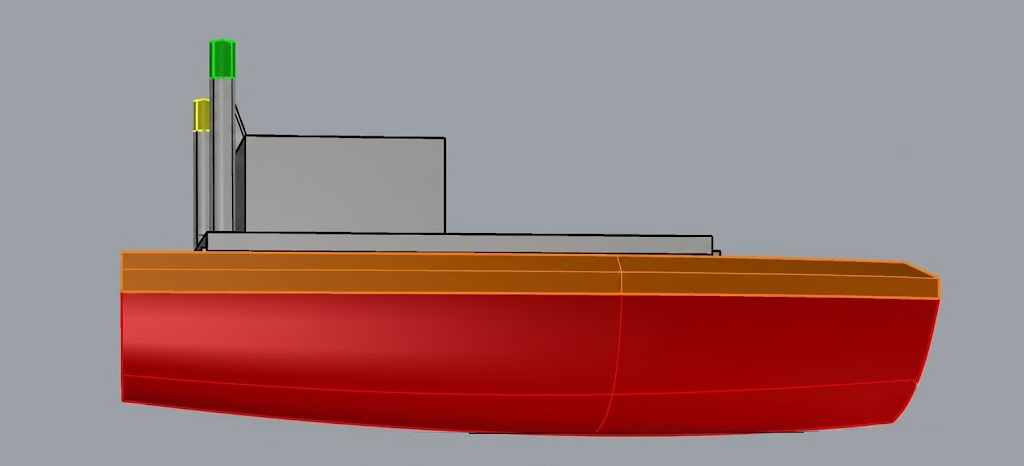
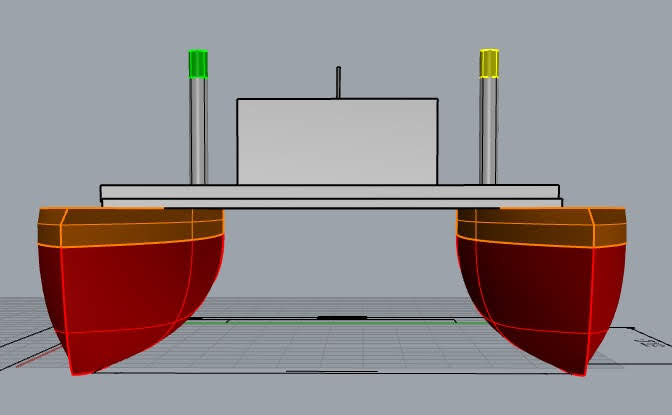
The platform combines sensing, navigation, communication, and propulsion subsystems into a single environmental monitoring solution.
Sensor Reading
Oil contamination is detected by onboard sensing modules
GPS Acquisition
GPS coordinates are continuously acquired for vessel tracking
LoRa Telemetry
Sensor and navigation data are transmitted through LoRa telemetry
HMI Interface
Operators monitor vessel status and environmental conditions through the HMI interface
Signal Flow
Oil Sensor → ESP32 → LoRa → Remote / HMI → Operator
GPS → LoRa → Remote Display
Hardware Components
- LoRa Module — Long-range wireless communication between vessel, remote, and HMI
- GPS Receiver — Real-time positioning and navigation
- LiFePO4 Battery Pack — Primary power source for propulsion and electronics
- Brushless Thruster + ESC — Vessel propulsion and maneuvering
- Remote Controller (Radiolink RC6GS) — Manual navigation and mission control
- HMI — Monitoring interface displaying sensor and GPS data
Implementation Results
The following section summarizes the implementation results, system performance, and oil-detection capability under different water conditions.
Integrated Oil Navigation System
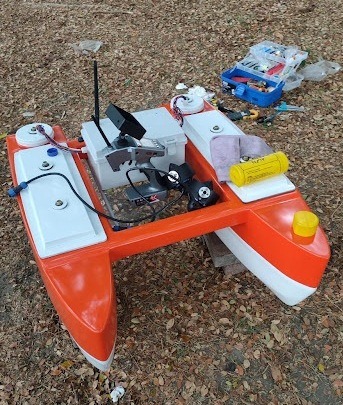
The completed system combines vessel navigation, oil-spill sensing, GPS positioning, and long-range wireless communication into a single operational platform for monitoring activities in marine environments.
Remote Control
A custom handheld controller was developed to provide manual navigation, telemetry monitoring, and Return-to-Home activation. Real-time vessel data were transmitted wirelessly through the LoRa communication link.
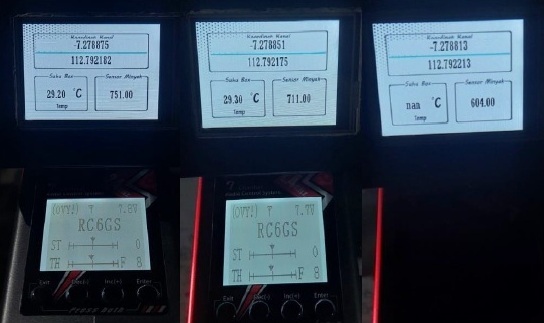
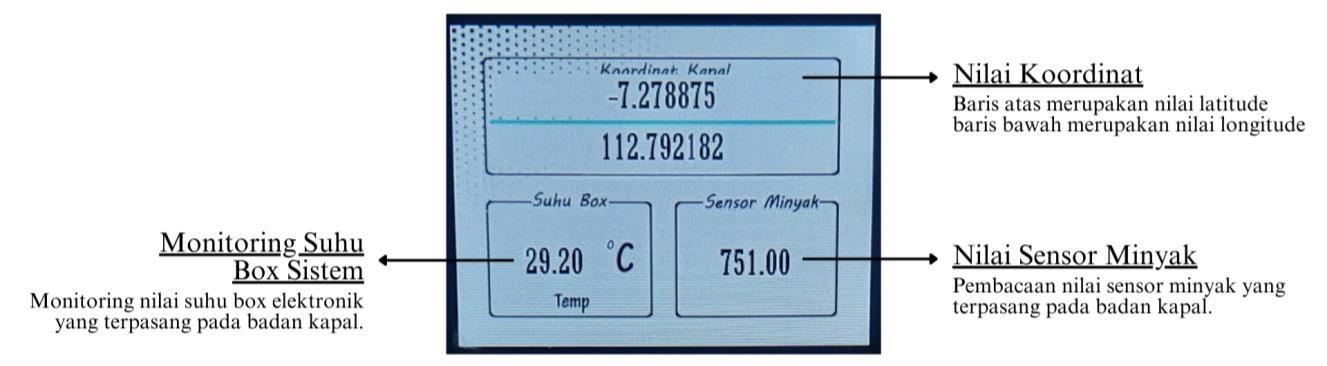
HMI & Monitoring Display
The monitoring interface provides real-time GPS coordinates, control-box temperature, and oil sensor readings. These parameters enable operators to track vessel position and identify potential oil-spill events during operation.
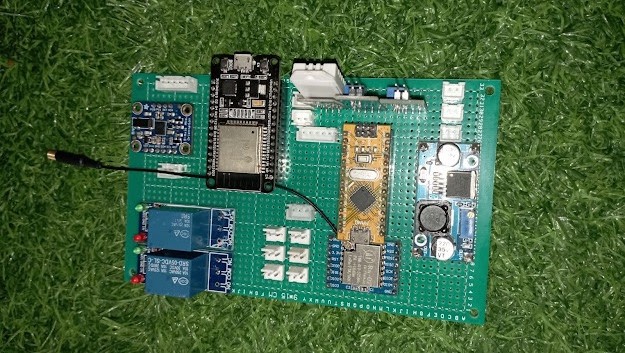
Onboard Electronics Integration
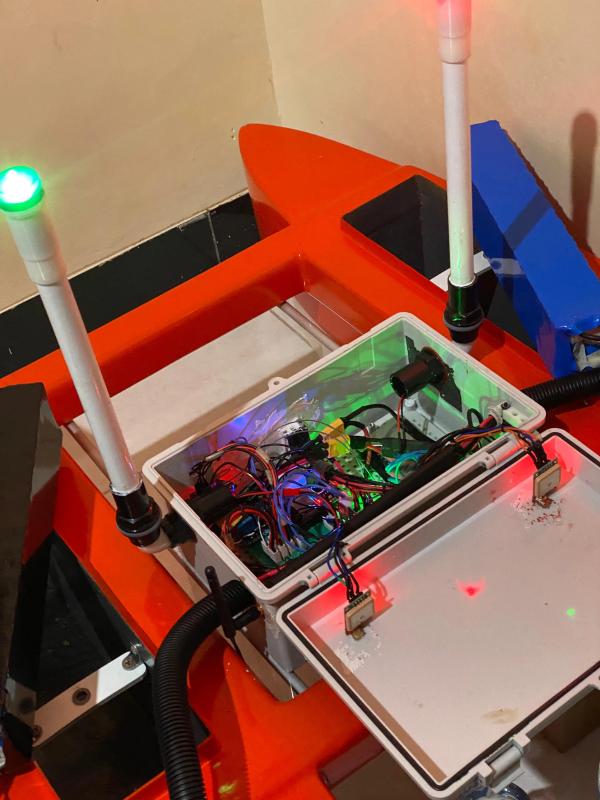
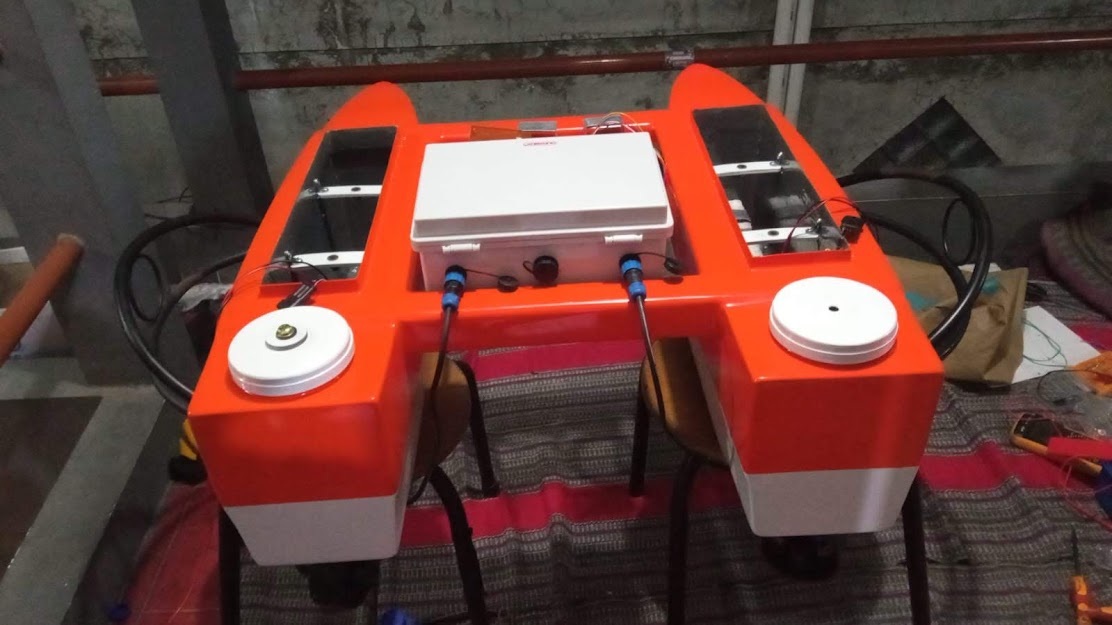
All control electronics — the ESP32, GPS module, LoRa transmitter, and relay boards — are housed in a sealed waterproof box mounted on the hull deck, with the GPS/RTH indicator LEDs and antennas mounted externally for reliable signal reception.
Performance Summary
| Metric | Value |
|---|---|
| Remote Contro Range | 600 m |
| Battery Voltage | 12.8 V |
| Battery Capacity | 43.2 Ah |
| Thruster Power | 410 W |
| Endurance | 90 min |
| Maximum Speed | 7 km/h |
Oil Sensor Validation
The oil sensor was tested across seawater, freshwater, and water with a thin oil layer to confirm it could reliably distinguish clean water from an oil-contaminated surface.
| Water Condition | Oil Layer | Oil Present | Sensor Value | Result |
|---|---|---|---|---|
| Freshwater | 0 cm | No | 751 | Not detected |
| Seawater | 0 cm | No | 604 | Not detected |
| Freshwater | 0,5 cm | Yes | 395 | Detected |
| Seawater | 1 cm | Yes | 420 | Detected |
Key Findings
System validation confirmed reliable transmission of GPS coordinates, temperature readings, and contamination-detection data through LoRa communication, enabling effective remote monitoring in shallow-water environments.
Engineering Challenges & Improvements
PCB Short Circuit
Problem: Controller failure caused by a short circuit on the PCB trace.
Solution: PCB inspection with a multimeter followed by trace repair and controller replacement.
Servo Bracket Failure
Problem: Mechanical fatigue on the maneuvering servo bracket under repeated steering load.
Solution: Structural reinforcement using epoxy and additional support, with a redesigned two-sided lever to split the load.
Thruster Mount Damage
Problem: Thread damage on the thruster mounting assembly.
Solution: Redesigned mounting structure using larger fasteners.
System Validation
Integrated testing was performed to verify communication, navigation, propulsion, and monitoring functions under operational conditions.
Final Outcome
The project successfully demonstrated a remote-operated vessel capable of oil-spill monitoring, GPS tracking, and long-range telemetry communication.
The development process provided practical experience in embedded systems, wireless communication, power management, marine automation, mechanical design, and multidisciplinary system integration.